
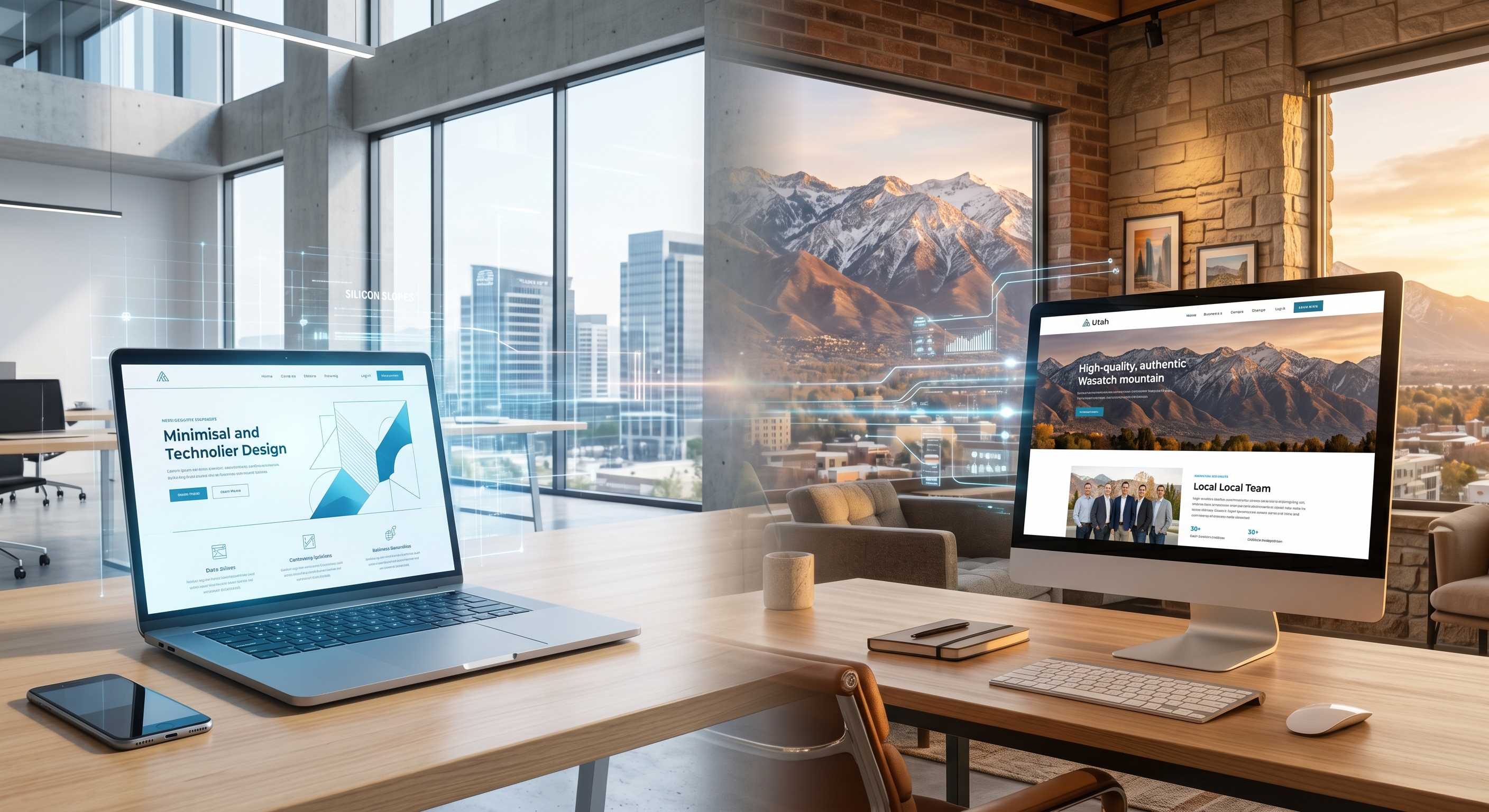
If you’ve spent any time around Lehi, Draper, or downtown Salt Lake City, you are already deeply familiar with the “tech aesthetic.” Driven by the rapid growth of Silicon Slopes, this design language is everywhere: minimalist typography, abundant white space, abstract geometric shapes, and bold, punchy copywriting.
It looks great—to a point.
But Utah is not just a homogenous tech corridor. It is a relationship-driven, community-focused, and highly practical market. When a website’s design leans too far into either extreme—the ultra-modern tech clone or the outdated traditional template—credibility begins to fracture.
The strongest brands in the Beehive State understand how to balance modern UI/UX principles with authentic, localized trust signals.
The Two Design Extremes That Undermine Buyer Trust
In the Utah digital landscape, we frequently see businesses lose conversions by falling into one of two design traps:
1. The Over-Polished “Silicon Slopes” Clone
This website looks exactly like a recently funded SaaS startup, regardless of the actual industry. It relies heavily on abstract vector art, vague value propositions, and lacks any real local context. While it feels sleek, it also feels distant. For many Utah buyers—especially those outside the core tech sector—this hyper-modern approach feels impersonal and creates a barrier to entry.
2. The Outdated “Legacy Local” Template
On the opposite end of the spectrum is the business relying on a decade-old template. It is packed with generic stock photos, crowded navigation menus, and lacks a cohesive brand identity. While the business itself might be a staple in Utah County, the website feels unprofessional. In a market this competitive, “safe and familiar” design often translates to “outdated and incapable,” driving users straight to competitors.
According to Stanford’s Web Credibility Research, 75% of users admit to making judgments about a company’s credibility based purely on their website’s design. If your aesthetic doesn’t match your audience’s expectations, you lose them before they even read your services.
Why Utah Buyers Respond to Visual Balance
Utah’s economy is a unique blend of high-growth tech firms, deeply established B2B sectors, and generational family-owned companies. Because of this, local buyers expect a specific hybrid of design cues. They want:
- Professional Polish: Evidence that you are a modern, capable operation.
- Clear Messaging: Straightforward explanations of what you do, without the Silicon Valley jargon.
- Evidence of Stability: Visual proof that you are established and reliable.
- Local Familiarity: Subtle nods to the local market that prove you aren’t just an out-of-state lead generation shell.
Your website must signal capability without feeling corporate, and it must signal local presence without feeling antiquated. That specific balance builds trust faster than either extreme.
What the “Utah Aesthetic” Looks Like in Practice
Effective, conversion-driven web design in Utah isn’t about compromising; it’s about strategic integration. At Infogenix, we build sites that leverage:
- Clean, Modern Architecture: Utilizing standard UX/UI best practices so the site is fast, mobile-responsive, and easy to navigate.
- Intentional Local Imagery: Using high-quality photography of actual teams, local projects, or subtle environmental cues rather than generic corporate stock photos.
- Organized Information Architecture: Clearly defining services so users don’t have to hunt for what they need.
- Frictionless Conversion Paths: Implementing strong, strategically placed calls-to-action (CTAs) that invite engagement without feeling aggressive.
The Conversion-First Competitive Edge
In Utah’s dense digital market, visual similarity is a massive liability. If your brand looks indistinguishable from three other competitors in Salt Lake, the buyer’s decision defaults entirely to price.
However, when your design actively reinforces your authority and local relevance, you differentiate your brand without having to shout. When the visual aesthetic matches buyer expectations, cognitive friction drops. And when friction drops, your conversion rates improve—even if your daily traffic stays exactly the same.
If your website has high traffic but low engagement, or if it feels visually disconnected from the actual quality of the work you do, the issue likely isn’t your marketing—it’s your perceived credibility.
That’s where strategic custom web design changes the game. By balancing Utah’s tech-forward momentum with the authentic trust signals local buyers expect, you turn your website from a digital brochure into a revenue-generating asset.