
Why Utah Customers Leave Your Website in Seconds (And You Don’t Even Notice)

Why Utah Customers Leave Your Website in Seconds (And You Don’t Even Notice)

Have you ever pulled up your own website and just stared at it for a second? Not as the business owner, but as someone who has never seen it before.

Most Utah business owners don’t do this—and their bounce rates show it.

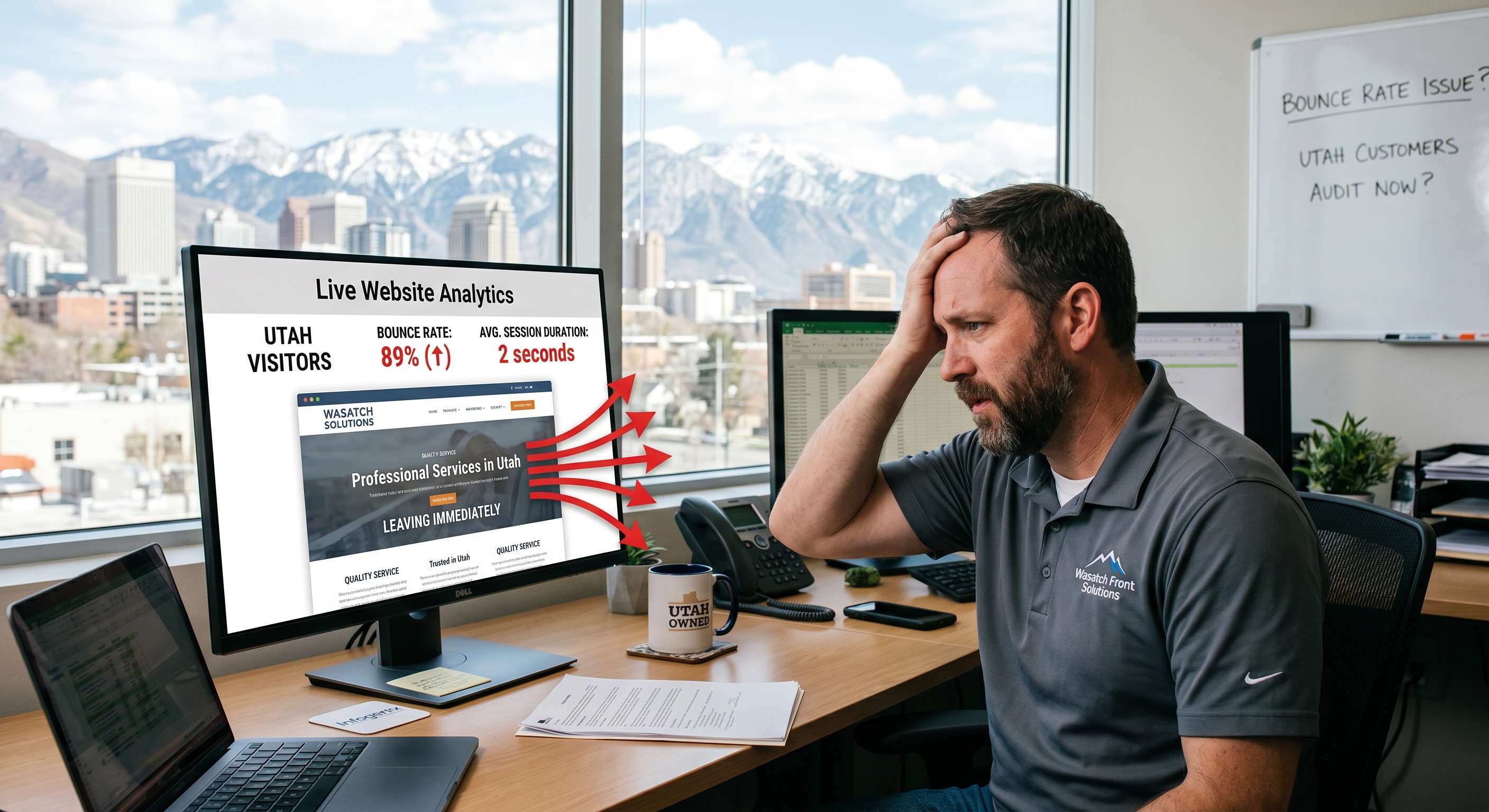
Quietly, every single day, people are landing on your site, looking around for maybe 2 to 3 seconds, and then leaving without taking action. No phone call. No submitted form. No second thought.

The most frustrating part? You usually don’t even realize it’s happening.

It’s Not That People Aren’t Interested

Most business owners assume: “I just need more traffic.”

But traffic is rarely the root issue. Utah is a highly competitive market, especially along the Wasatch Front. People are actively searching, clicking, and checking out your services.

However, they are also making lightning-fast decisions. It isn’t just impatience; it’s because they have options. When a prospective customer lands on your site, they are subconsciously asking one simple question:

“Am I in the right place?”

If the answer isn’t immediately obvious, they bounce.

The First Few Seconds Do All the Heavy Lifting

Think about how modern consumers actually browse online. They aren’t reading; they are scanning.

They quickly evaluate:

  • The main headline
  • The hero image
  • The primary Call-to-Action (CTA) button

From that three-second glance, they make a snap judgment: “Yes, this looks right,” or “Nope, moving on.”

In our years of auditing Utah business sites, we see companies miss this crucial moment all the time. Not because they are bad businesses, but because their websites are built from the inside out. The messaging makes perfect sense to the internal team, but it fails to connect with a cold prospect.

What Your Customers See (That You Don’t)

Here is what conversion friction looks like from the outside:

1. “Wait… what do they actually do?” Your headline might sound nice, but it’s too vague. Catchphrases like “Delivering Excellence” or “Your Trusted Partner” don’t mean anything to someone landing on your site for the first time. They are simply trying to figure out: “Do you solve my specific problem or not?”

2. “This feels like work to figure out.” If a visitor has to scroll endlessly, click through multiple menus, or think too hard just to understand your core offering, they will leave. It’s not because they are lazy; it’s because a competitor with a clearer message is just one click away.

3. “I don’t know what to do next.” Without a strong, obvious next step, users get stuck. If your site just offers a menu, blocks of text, and a button that blends into the background, people will take no action at all. And online, doing nothing equals leaving.

A Quick Reality Check

Pull up your website on your smartphone right now. (Not your laptop—your phone).

Ask yourself honestly:

  • Can I tell exactly what this company does in 2 seconds?
  • Is it obvious who the target audience is?
  • Is there a clear, clickable next step visible without scrolling?

If you had to pause and think about any of those answers, that is exactly what your potential customers are experiencing.

The Conversion Bottleneck: Where Utah Businesses Get Stuck

This isn’t necessarily a “bad website” problem; it’s a clarity problem. Most underperforming sites are slightly unclear, slightly slow, and slightly unfocused. Individually, these issues don’t seem catastrophic. But together, they quietly cost you leads and revenue every single day.

When a website achieves total clarity, the user experience transforms. A visitor lands and immediately thinks, “Yes—this is exactly what I need.” They don’t hesitate, and they stop comparing you to the competition. They just move forward.

Same traffic. Same business. Just a much clearer message.

Stop Guessing Why They’re Leaving

If you’ve never looked at your site through this lens, it’s time to find out what is really happening. You might not need a massive rebuild or an expensive project—sometimes, fixing that crucial first impression changes the entire trajectory of your digital marketing.

Get an expert set of eyes on your site. Let the Infogenix team show you exactly where you’re losing traffic, and how to fix it.

Contact us today for a website review and start turning those bounces into business.
Conversion-First Design: Why Your Site’s ‘Bounce Rate’ is Killing Your Utah Growth

Conversion-First Design: Why Your Site’s ‘Bounce Rate’ is Killing Your Utah Growth

You just launched a brand new website. The photography is stunning, the typography is perfectly modern, and it perfectly captures that coveted Utah “tech-meets-local” aesthetic. The site looks like a million bucks.

But your lead volume hasn’t budged.

This is the most common trap businesses in the Silicon Slopes and along the Wasatch Front fall into: building a beautiful website that functions as an expensive digital art project, rather than a revenue-generating engine. If you are investing heavily in SEO or PPC to drive traffic to your site, but that traffic isn’t converting, you don’t have a marketing problem. You have a UX (User Experience) problem. Here is why Conversion-First Design is the only way to stop bleeding ad spend and start capturing high-intent Utah buyers.

The “Pretty but Broken” Trap

In digital marketing, your Bounce Rate is the percentage of visitors who land on your website and leave without navigating to a second page or taking a single action.

Imagine paying a billboard company to drive 100 people to your physical storefront in Orem. They walk through the front door, look around for three seconds, and immediately walk back out. You wouldn’t blame the billboard; you would blame the store layout.

A high bounce rate indicates high cognitive friction. When a Utah buyer visits your site, they are usually trying to answer three subconscious questions within milliseconds:

  1. Am I in the right place?
  2. Do I trust these people?
  3. How do I take the next step?

If your design forces them to hunt for a phone number, read through a wall of dense corporate jargon, or wait for a massive background video to load, that friction causes them to abandon ship and click on your competitor.

The Pillars of Conversion-First Design

Conversion Rate Optimization (CRO) is the scientific process of improving your website’s design to increase the percentage of visitors who become customers. To turn a website into a conversion machine, we focus on three critical pillars:

1. Mobile Speed and Core Web Vitals

Utah has a highly mobile, on-the-go demographic. If your site isn’t optimized for mobile, you are losing leads. But “mobile-friendly” is no longer enough; it must be lightning fast.

Google’s Core Web Vitals (the metrics Google uses to measure user experience) strictly penalize slow-loading sites. If your beautiful high-resolution images take 4 seconds to load on a 5G connection in Lehi, the user is gone. Conversion-first design relies on optimized code, compressed media, and rapid server response times. Speed is directly tied to revenue.

2. Intentional Information Architecture

How you structure your data matters just as much as how it looks. According to the Nielsen Norman Group, a leading authority on user experience, users rarely read web pages linearly; they scan in predictable patterns.

Your most important value propositions and calls-to-action (CTAs) must intersect with these natural eye-tracking patterns. This means:

  • Placing a clear, contrasting “Get a Quote” or “Call Now” button in the top right corner.
  • Breaking up text with bullet points and bold headers.
  • Moving your strongest social proof (Utah-based reviews, partner logos) “above the fold” so they are seen immediately without scrolling.

3. Data-Driven Iteration (Heatmaps & Testing)

The biggest mistake companies make is designing a website based on what the CEO likes, rather than what the data proves.

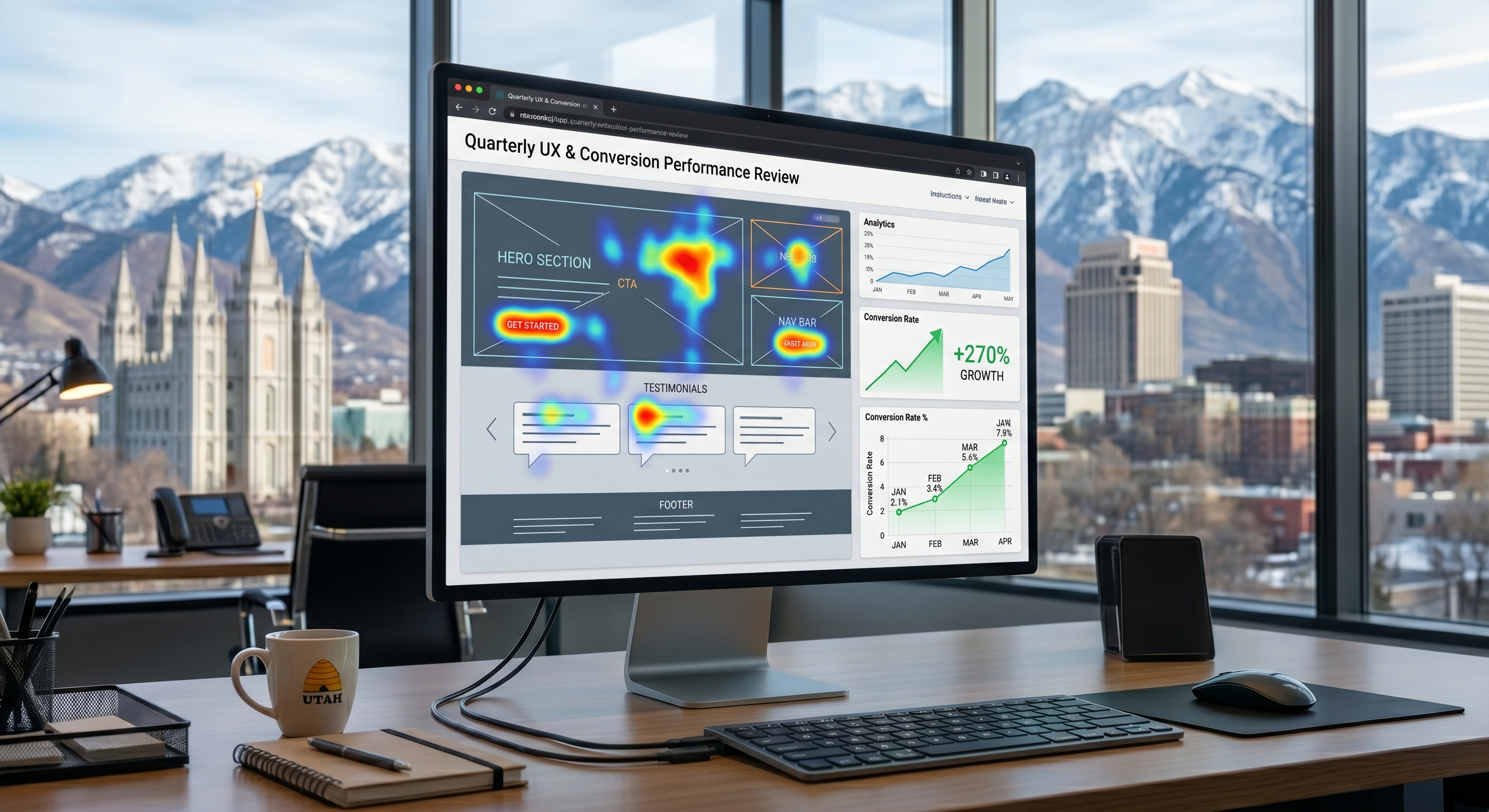
Modern custom web design doesn’t rely on guesswork. By deploying heatmapping tools, we can see exactly where real users are clicking, how far down the page they scroll, and where they get frustrated and leave. If a heatmap shows that 80% of users drop off right before your pricing form, we know exactly where the friction point is.

We then use A/B testing to pit two different design variations against each other, allowing actual user behavior to dictate the winning layout.

Stop Guessing. Start Converting.

Driving traffic to a poorly converting website is like pouring water into a leaky bucket. Before you increase your ad spend or launch another SEO campaign, you must ensure the bucket is sealed.

At Infogenix, we don’t just build websites that look good. We engineer digital storefronts backed by behavioral psychology, rigorous data tracking, and conversion-first UX principles. Because in the competitive Utah market, design without data is just a brochure—but design driven by data is a competitive advantage.

The Utah Search Landscape: Moving Beyond ‘Near Me’ to Local Authority

The Utah Search Landscape: Moving Beyond ‘Near Me’ to Local Authority

For years, the gold standard of local search was simply ranking for “service + near me.” If your business was physically located in Sandy, and someone in Sandy searched for your service, your Google Business Profile popped up.

But the Utah digital landscape has fundamentally changed.

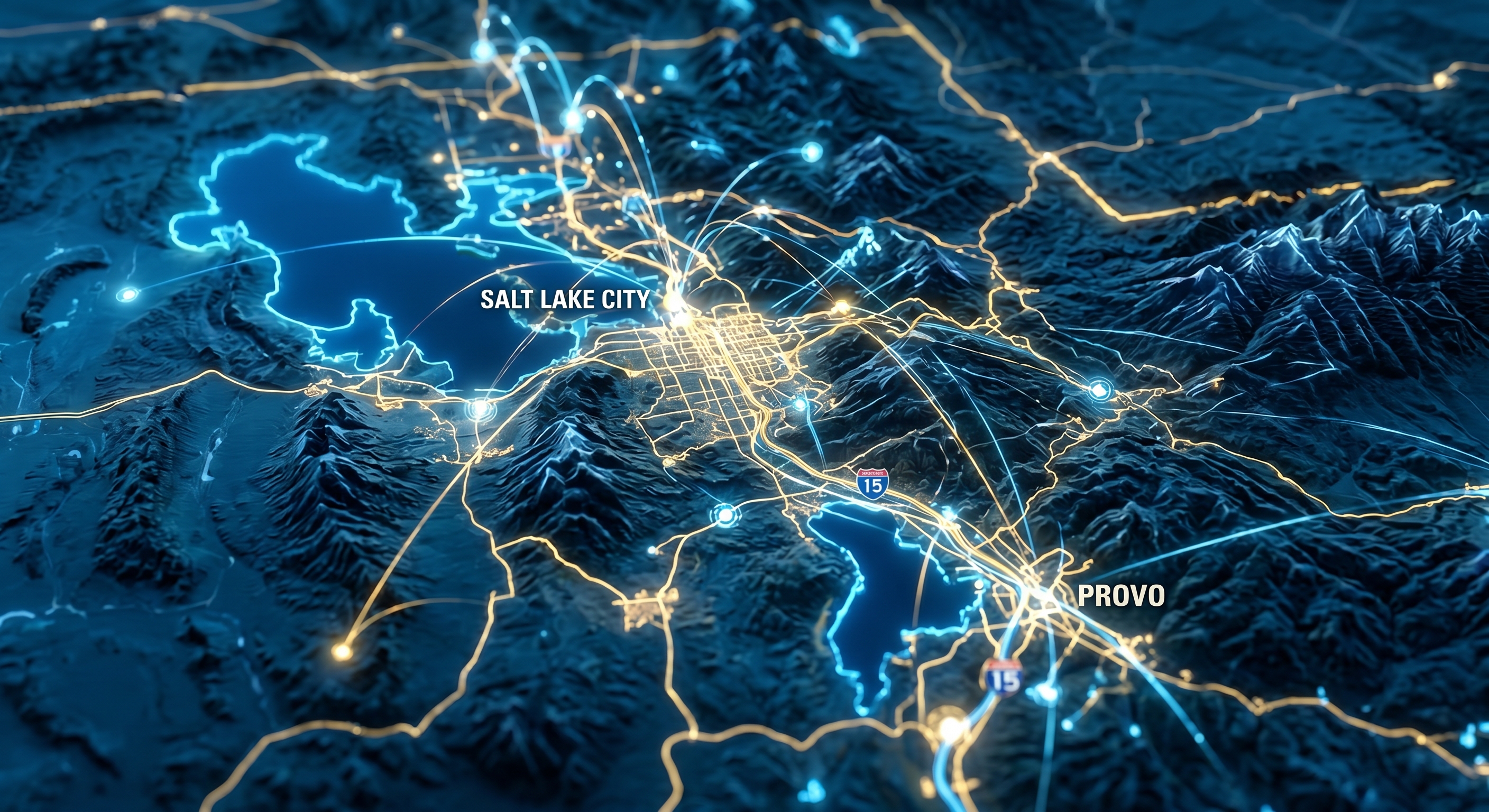
The I-15 corridor—stretching from Ogden down to Provo—is now one of the densest, most competitive economic zones in the country. Businesses are no longer just competing with the shop down the street; they are competing with enterprise brands, national franchises, and highly aggressive local startups.

In a market this saturated, a basic Google Business Profile and a few keyword-stuffed web pages won’t generate meaningful revenue. To dominate the Utah search landscape, brands must evolve from basic local targeting to Entity-Based SEO and hyper-local authority building.

Here is how the top-performing companies in Utah are restructuring their search strategies to win.

The Problem with the “Near Me” Strategy in Utah

The core issue with relying solely on proximity-based search is that it artificially limits your growth. If your office is in Lehi, Google’s standard algorithm heavily favors you for searches happening inside Lehi.

But what if your ideal clients are executives in Draper, homeowners in Daybreak, or students in Orem?

Relying on proximity means you surrender those surrounding micro-markets to competitors who are physically closer to the searcher. To break out of your immediate zip code, you have to prove to Google that your website is the definitive, authoritative answer for the entire region.

Enter Entity-Based SEO

Search engines have evolved from “lexical search” (matching words on a page to words in a search bar) to “semantic search.” According to Google’s own documentation on how search works, their algorithms now aim to understand the meaning and context behind queries.

This is driven by entities. An entity is a singular, unique, well-defined thing or concept—like a specific business, a city, or a service.

Entity-Based SEO is the process of connecting your business to the broader knowledge graph of your region. Instead of just writing “SEO Company Utah” 50 times on a page, you structure your website so Google understands the relationship between your business, the local economy, surrounding cities, and your specific industry expertise.

When Google trusts your entity as a regional authority, it will rank you in neighboring cities even if you don’t have a physical address there.

Building Location-Specific Content Clusters

To build this entity authority across the Wasatch Front, you must abandon the outdated practice of “doorway pages” (creating 20 identical pages and just swapping out the city name). Google’s Helpful Content Update actively penalizes this type of shallow, unhelpful content.

Instead, effective SEO strategies rely on Content Clustering.

This means building dedicated, deeply researched hubs for your core markets. A page targeting Salt Lake City should read entirely differently than a page targeting Orem.

  • The Salt Lake Page: Might focus on corporate logistics, downtown zoning, or higher-density B2B services, linking to local case studies in Salt Lake County.
  • The Orem Page: Might shift focus to family-centric services, university demographics (UVU), and suburban pain points.

By providing genuine, localized value, you signal deep expertise to both the user and the search engine algorithm.

Off-Page Authority: The Local Digital Handshake

Authority isn’t just about what you say on your own website; it’s about who vouches for you. In traditional digital marketing, this means building backlinks.

For Utah businesses, generic backlinks from out-of-state blogs provide minimal value. You need a “Local Digital Handshake.” This involves earning links from other trusted Utah entities:

  • Local Chambers of Commerce (Silicon Slopes, Salt Lake Chamber)
  • Utah-based business journals and news outlets
  • Sponsorships of local high school teams, university events, or charities
  • Strategic partnerships with complementary local businesses

These localized links act as powerful trust signals, cementing your business as an authoritative pillar in the Utah community.

Winning the I-15 Search War

The days of easy, proximity-based wins are over. As Utah’s economy continues its explosive growth, the businesses that treat search engine optimization as a deeply integrated, authoritative strategy are the ones capturing market share.

If your website isn’t actively generating leads outside of your immediate zip code, it’s time to rethink your foundation. At Infogenix, we engineer advanced, entity-based SEO campaigns that push past proximity limits and establish true regional dominance.

Posted in SEO