
You just launched a brand new website. The photography is stunning, the typography is perfectly modern, and it perfectly captures that coveted Utah “tech-meets-local” aesthetic. The site looks like a million bucks.
But your lead volume hasn’t budged.
This is the most common trap businesses in the Silicon Slopes and along the Wasatch Front fall into: building a beautiful website that functions as an expensive digital art project, rather than a revenue-generating engine. If you are investing heavily in SEO or PPC to drive traffic to your site, but that traffic isn’t converting, you don’t have a marketing problem. You have a UX (User Experience) problem. Here is why Conversion-First Design is the only way to stop bleeding ad spend and start capturing high-intent Utah buyers.
The “Pretty but Broken” Trap
In digital marketing, your Bounce Rate is the percentage of visitors who land on your website and leave without navigating to a second page or taking a single action.
Imagine paying a billboard company to drive 100 people to your physical storefront in Orem. They walk through the front door, look around for three seconds, and immediately walk back out. You wouldn’t blame the billboard; you would blame the store layout.
A high bounce rate indicates high cognitive friction. When a Utah buyer visits your site, they are usually trying to answer three subconscious questions within milliseconds:
- Am I in the right place?
- Do I trust these people?
- How do I take the next step?
If your design forces them to hunt for a phone number, read through a wall of dense corporate jargon, or wait for a massive background video to load, that friction causes them to abandon ship and click on your competitor.
The Pillars of Conversion-First Design
Conversion Rate Optimization (CRO) is the scientific process of improving your website’s design to increase the percentage of visitors who become customers. To turn a website into a conversion machine, we focus on three critical pillars:
1. Mobile Speed and Core Web Vitals
Utah has a highly mobile, on-the-go demographic. If your site isn’t optimized for mobile, you are losing leads. But “mobile-friendly” is no longer enough; it must be lightning fast.
Google’s Core Web Vitals (the metrics Google uses to measure user experience) strictly penalize slow-loading sites. If your beautiful high-resolution images take 4 seconds to load on a 5G connection in Lehi, the user is gone. Conversion-first design relies on optimized code, compressed media, and rapid server response times. Speed is directly tied to revenue.
2. Intentional Information Architecture
How you structure your data matters just as much as how it looks. According to the Nielsen Norman Group, a leading authority on user experience, users rarely read web pages linearly; they scan in predictable patterns.
Your most important value propositions and calls-to-action (CTAs) must intersect with these natural eye-tracking patterns. This means:
- Placing a clear, contrasting “Get a Quote” or “Call Now” button in the top right corner.
- Breaking up text with bullet points and bold headers.
- Moving your strongest social proof (Utah-based reviews, partner logos) “above the fold” so they are seen immediately without scrolling.
3. Data-Driven Iteration (Heatmaps & Testing)
The biggest mistake companies make is designing a website based on what the CEO likes, rather than what the data proves.
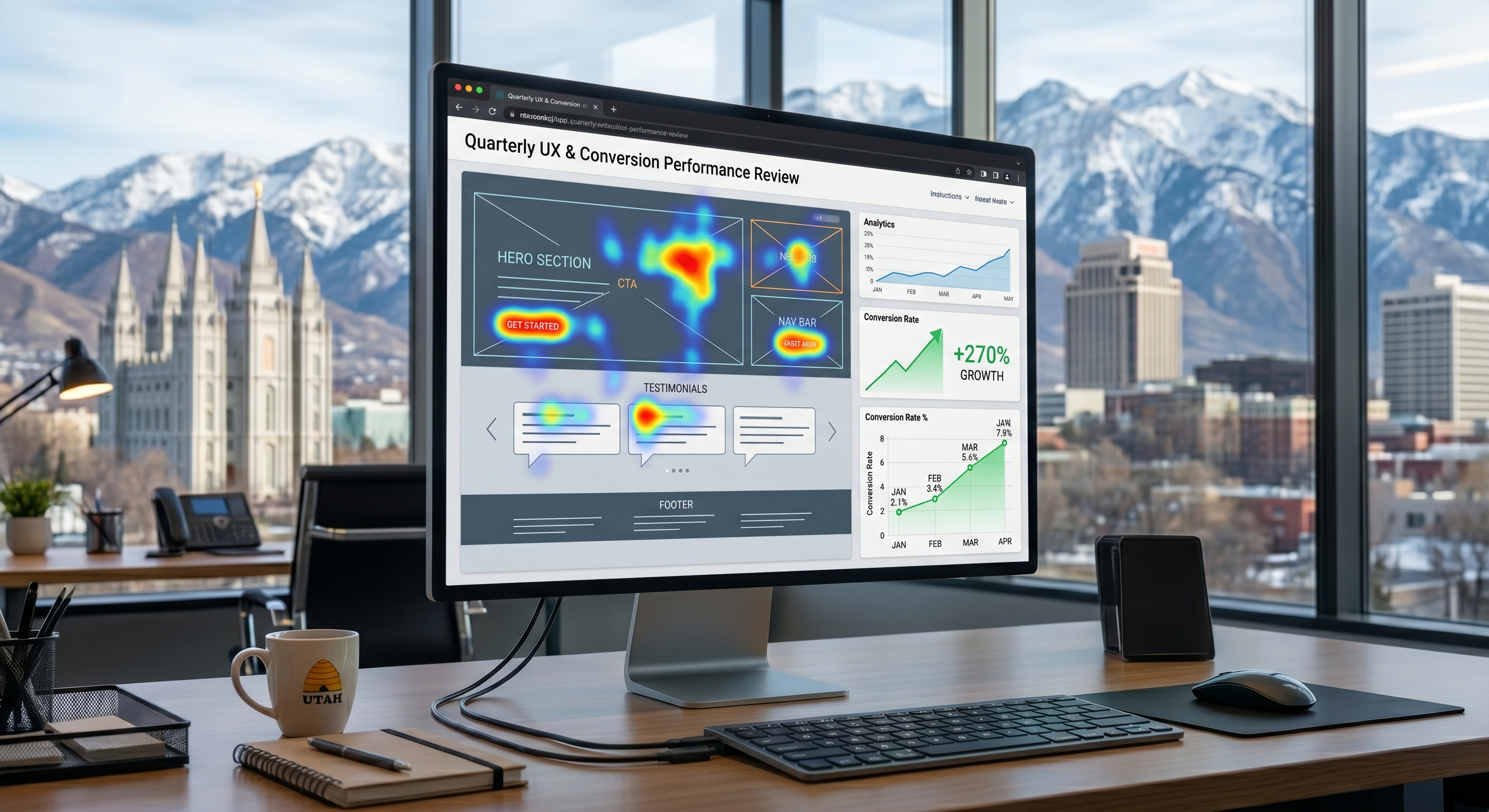
Modern custom web design doesn’t rely on guesswork. By deploying heatmapping tools, we can see exactly where real users are clicking, how far down the page they scroll, and where they get frustrated and leave. If a heatmap shows that 80% of users drop off right before your pricing form, we know exactly where the friction point is.
We then use A/B testing to pit two different design variations against each other, allowing actual user behavior to dictate the winning layout.
Stop Guessing. Start Converting.
Driving traffic to a poorly converting website is like pouring water into a leaky bucket. Before you increase your ad spend or launch another SEO campaign, you must ensure the bucket is sealed.
At Infogenix, we don’t just build websites that look good. We engineer digital storefronts backed by behavioral psychology, rigorous data tracking, and conversion-first UX principles. Because in the competitive Utah market, design without data is just a brochure—but design driven by data is a competitive advantage.