

AI Search & Answer Engine Optimization
Search has fundamentally changed. Millions of people are getting answers from AI — not from search result pages. The businesses showing up in those answers are winning customers your analytics will never show you. We get you into the answer.
The Search Result Is No Longer the Destination
Something significant happened to search over the past two years — and most businesses have not fully reckoned with what it means.
When someone opens Google and asks "who is the best HVAC company in Salt Lake City," they used to see a list of links. Now they see a paragraph. Google’s AI reads the web on their behalf, synthesizes an answer, and delivers a recommendation directly on the results page. The user gets what they need. They do not click. The businesses mentioned in that AI-generated answer get the credibility signal. The businesses not mentioned do not exist.
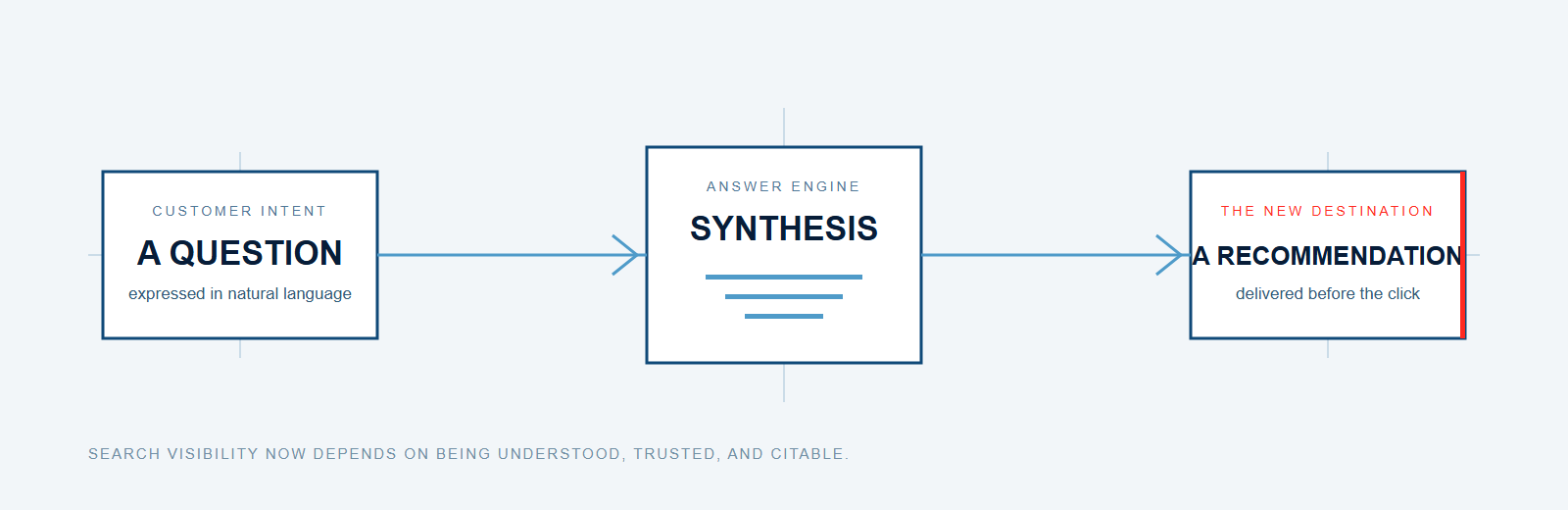
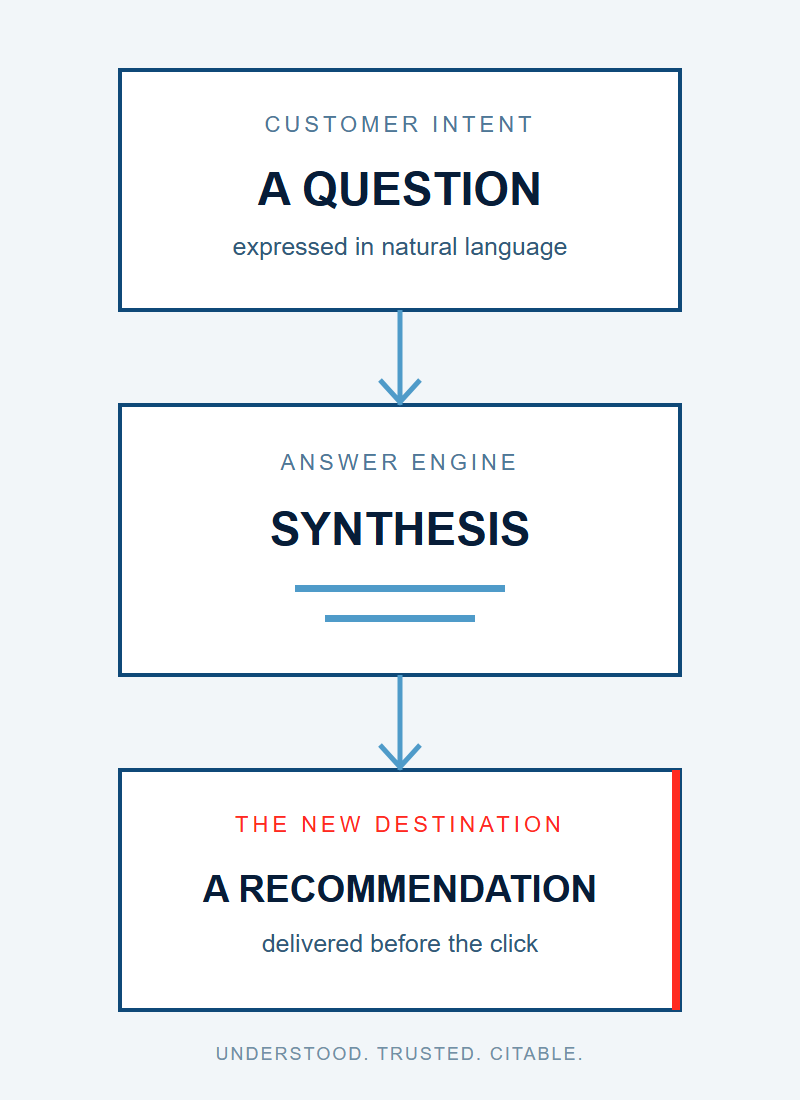
This is not a future scenario. It is happening right now — in your market, for your most valuable keywords, to your customers. Google AI Overviews appear on a significant and growing percentage of commercial searches. Perplexity is being used by millions of people every day as a search replacement. ChatGPT processes hundreds of millions of queries per week, many of them about products, services, and local businesses.
The question is not whether AI search is relevant to your business. The question is whether your business is relevant to AI search.
At Infogenix, we have built a practice around Answer Engine Optimization — the discipline of making your business visible, credible, and citable to the AI systems that are reshaping how people find and choose businesses. We are based in Orem and have been working at the intersection of search, content, and technology for over 25 years. AEO is the most significant evolution in search we have ever seen — and we are helping Utah businesses get ahead of it while most of their competitors are still deciding whether to pay attention.
Five Signals That Determine Whether AI Recommends Your Business
AI search tools do not rank websites the way traditional search engines do. They evaluate businesses through a different set of signals — and understanding those signals is the foundation of everything we do in AEO. Here is what AI is actually looking for:
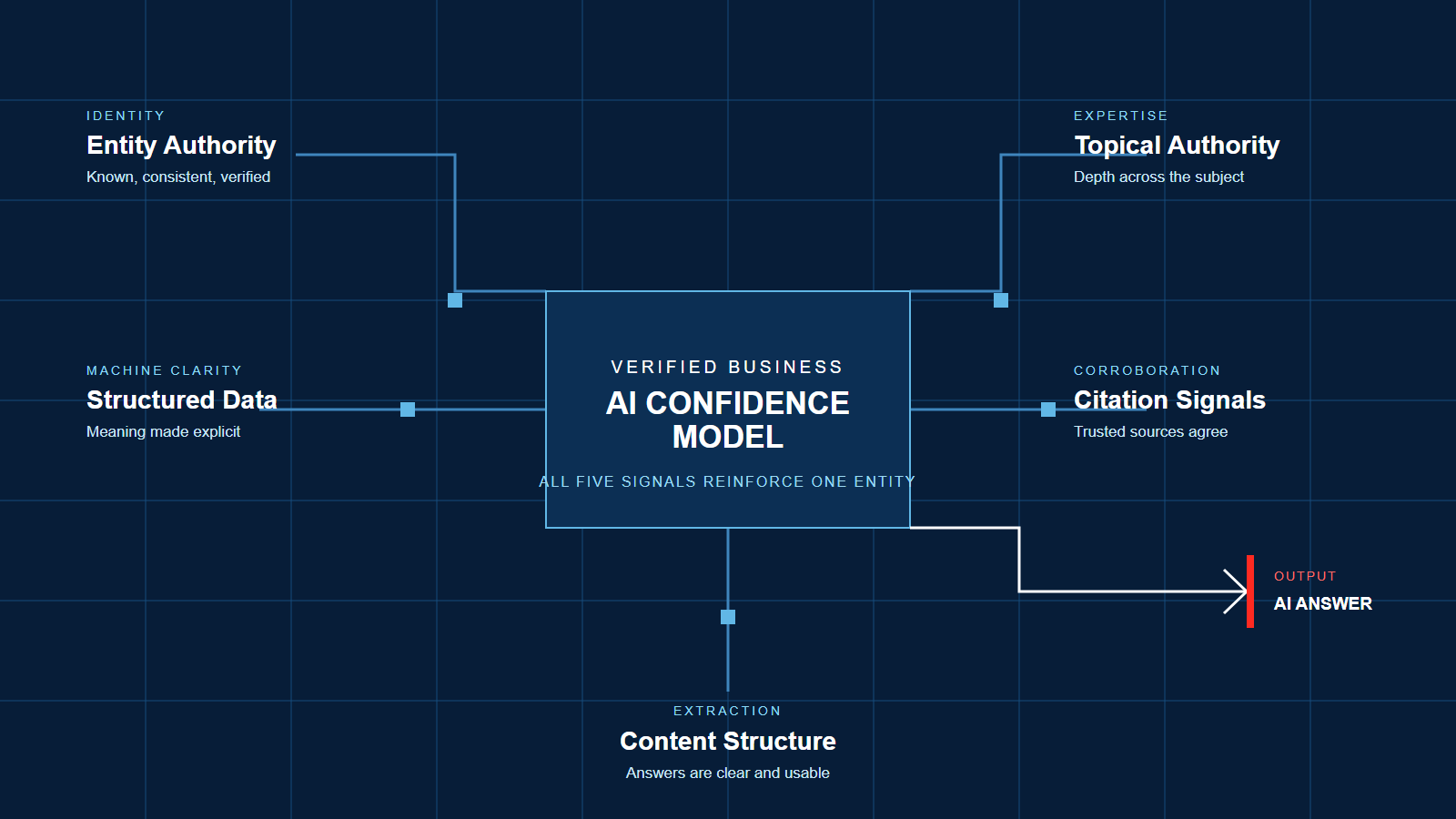
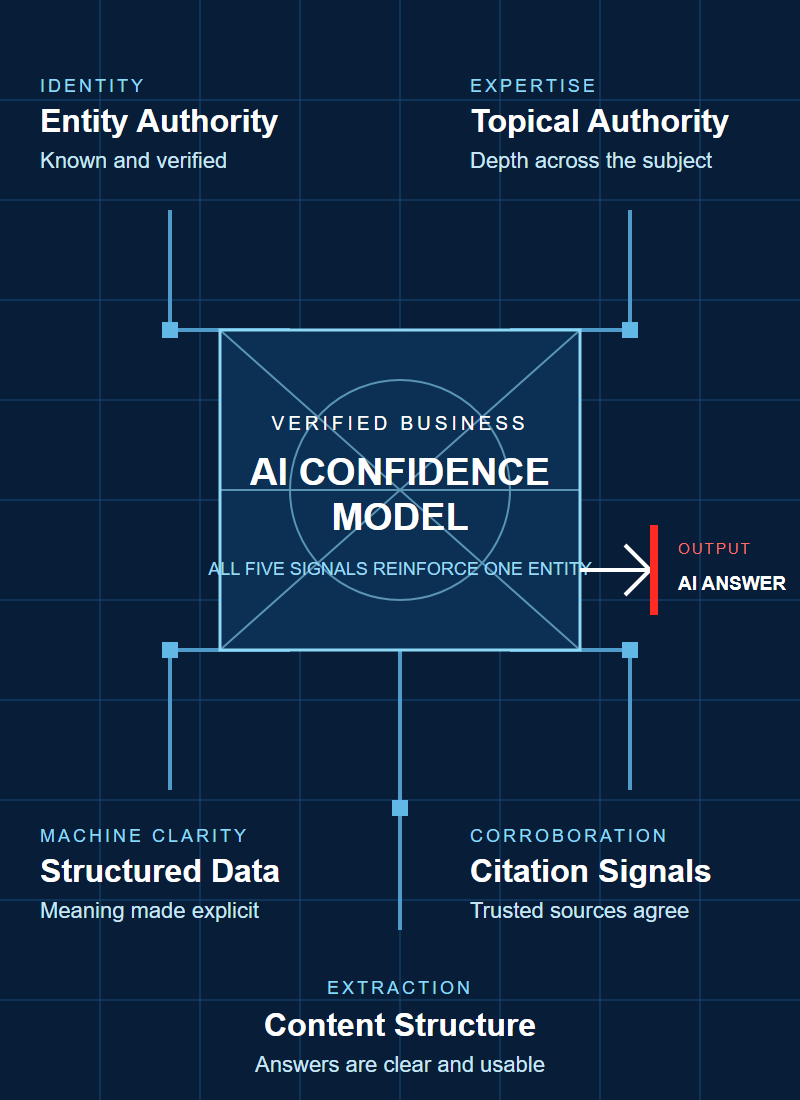
Signal 1: Entity Authority — Does AI Know Your Business Is Real?
AI systems build their understanding of the world from a web of entities — people, places, organizations, and concepts — and the relationships between them. Before an AI tool will confidently recommend your business, it needs to recognize your business as a verified, established entity in its knowledge base.
Entity authority is built through consistent business information across trusted sources — your Google Business Profile, Wikipedia (if applicable), data aggregators, authoritative industry directories, and press coverage that references your business by name. Inconsistent, sparse, or absent entity signals cause AI tools to be uncertain about your business — and uncertain sources do not get recommended.
Signal 2: Topical Authority — Does AI Trust Your Expertise?
AI tools are remarkably good at evaluating depth of expertise. A website with one service page and a few generic blog posts reads very differently to an AI system than a website with comprehensive coverage of every relevant topic in its domain — detailed guides, specific answers to real customer questions, technical depth across related subtopics.
Topical authority is built through strategic, sustained content development. It is not about publishing frequently — it is about publishing comprehensively. The businesses that AI tools cite most consistently are the ones that have clearly established expertise across their entire subject area, not just their core service keyword.
Signal 3: Structured Data — Are You Speaking AI’s Language?
AI systems read the web through structured data — specifically, schema markup that labels your content in machine-readable format. Without proper schema implementation, AI tools have to infer what your content means. With it, you are telling them directly: this is a local business, these are its services, this is its location, these are its hours, these are what customers say about it.
Schema markup is the single most direct technical signal you can send to AI search systems. LocalBusiness schema, Service schema, FAQ schema, Review schema, and Article schema each communicate specific, verifiable information that AI tools use to build their understanding of your business and decide when to recommend it.
Signal 4: Citation Signals — Are Trusted Sources Vouching for You?
AI tools do not form their opinions in a vacuum. They are heavily influenced by what other credible, authoritative sources on the internet say about you — news coverage, industry publications, association memberships, expert mentions, and high-quality backlinks. The more credible voices that reference your business in context, the more confident an AI system is in recommending you.
This is why digital PR, quality link building, and presence in authoritative local and industry directories are not just traditional SEO strategies — they are direct AEO signals. A feature in KSL, a mention in Utah Business Magazine, a listing in a respected industry association — each one increases the confidence AI systems have in your business as a recommendable source.
Signal 5: Content Structure — Is Your Content Formatted for Extraction?
AI tools do not read content the way humans do. They extract answers, definitions, comparisons, and recommendations from content that is clearly structured to deliver them. Pages that answer questions directly, in clear and specific language, under descriptive headings, with supporting detail — these are the pages AI tools pull from. Dense paragraphs of promotional copy are not.
Content structured for AI extraction uses clear question-and-answer formatting, direct definitions, step-by-step processes, and explicit answers to the queries AI is asked to resolve. This is not about dumbing down your content — it is about making your expertise extractable.
How We Build AI Search Visibility for Utah Businesses
AEO is not a single tactic — it is a coordinated strategy built across five disciplines simultaneously. Here is exactly what that work involves:
Entity Optimization & Brand Establishment
The foundation of AI visibility is making sure AI systems know your business exists — and know what it is, where it is, what it does, and why it matters. We build and strengthen your digital entity presence across every platform AI tools use to verify business information.
We handle:
- Google Business Profile optimization as the primary entity anchor for local businesses
- Business information consistency audit and correction across all platforms where your entity appears
- Knowledge panel development and optimization — building the signals that influence how Google’s Knowledge Graph represents your business
- Industry directory and association presence for entity verification in your specific niche
- Brand mention monitoring and development — building the volume of credible web references that establish your entity authority
- Wikipedia and Wikidata evaluation for businesses with sufficient notability
- Social profile establishment and consistency across platforms AI tools index
Structured Data & Schema Markup for AI
Schema markup is where AEO gets technical — and where the gap between businesses that have done this correctly and those that haven’t is most apparent. We implement the full range of schema types that AI systems use to understand and recommend your business.
Schema types we implement for maximum AI visibility:
- LocalBusiness schema — comprehensive implementation including service area, hours, contact details, and geo-coordinates that AI tools use for local business queries
- Service schema — individual schema markup for every service you offer, enabling AI to match your specific capabilities to specific queries
- FAQ schema — structured question-and-answer markup on key pages that AI tools extract directly for query responses
- Review and AggregateRating schema — making your customer reviews visible to AI systems evaluating business credibility
- Article and BlogPosting schema — marking up content pieces for enhanced AI extraction and citation
- HowTo and Step schema — for process-based content that answers procedural queries AI tools frequently handle
- Speakable schema — emerging markup that specifically flags content suitable for voice and AI assistant responses
- BreadcrumbList and SiteNavigationElement schema — helping AI understand your site architecture and content hierarchy
Topical Authority Content for AI Citation
The content strategy that earns AI citation is more systematic and more comprehensive than standard blog publishing. It requires building genuine topic coverage — the kind of depth that signals to AI systems that your business is the authoritative source on your subject, not just a business with a website that mentions relevant keywords.
We develop AEO-focused content strategy that:
- Maps the complete landscape of questions your customers and AI tools ask about your industry, service, and market
- Builds pillar content that establishes broad topical authority — comprehensive guides that cover a subject completely enough that AI tools treat them as a reference source
- Develops cluster content that demonstrates depth across every subtopic and related question in your domain
- Creates direct-answer content specifically formatted for AI extraction — question-and-answer pages, definition pages, comparison pages, and how-to content
- Produces locally-relevant content that establishes authority in Utah markets specifically — content that answers the questions your Utah customers are actually asking AI tools
- Refreshes and upgrades existing content to meet the structural and depth requirements for AI citation
Google AI Overviews Optimization
Google’s AI Overviews — the AI-generated summaries that now appear above traditional organic results on a significant percentage of searches — represent the highest-visibility placement in Google search. Businesses that appear in AI Overviews for their target queries are receiving a credibility signal and brand impression that no paid ad can replicate.
Appearing in AI Overviews requires a specific combination of factors:
- Ranking well in traditional organic search for the relevant query — AI Overviews draw from pages already trusted by Google’s algorithm
- Content structured to directly answer the query in a clear, extractable format
- Strong E-E-A-T signals that tell Google your content is trustworthy and authoritative
- Proper schema markup that helps Google understand your content’s meaning and structure
- Sufficient domain and topical authority that Google trusts you as a source for that query type
We optimize specifically for AI Overviews by auditing which queries trigger them in your niche, identifying which of your pages are closest to being pulled in, and implementing the specific changes that move them across the threshold.
Perplexity & Third-Party AI Platform Optimization
Perplexity is a fundamentally different kind of AI search tool — one that actively searches the web in real time and cites its sources explicitly. When Perplexity recommends a business, it shows the user exactly which websites it is drawing from. That citation drives direct traffic, builds brand credibility, and creates a documented record of AI-driven visibility that is easier to track than Google AI Overviews.
Appearing in Perplexity results consistently requires:
- Strong organic search presence for the relevant queries — Perplexity draws from high-ranking, authoritative web sources
- Content that directly and completely answers the types of questions Perplexity users ask
- Consistent entity presence across the web that Perplexity can verify
- Authoritative backlinks from sources Perplexity’s systems already trust
We optimize for Perplexity as a distinct channel within every AEO campaign — tracking citation frequency, identifying which content types earn consistent mentions, and building the authority signals that increase citation rates over time.
For ChatGPT, Gemini, Claude, and other AI assistants, the optimization strategy is similar — building the web-wide authority, structured content, and entity signals that influence how these systems represent your business when users ask about your category, location, or specific services.
Voice Search & Conversational Query Optimization
Voice search — through Siri, Google Assistant, Alexa, and other voice interfaces — processes queries differently than typed search. Voice queries tend to be longer, more conversational, and more question-based. "What is the best-rated HVAC company near me" is a voice query. "HVAC Orem Utah" is a typed query. Both need to be captured, but they require different content and optimization approaches.
As AI assistants become more capable and more integrated into daily life — in cars, in homes, on phones — voice-driven local business queries are growing. Optimizing for these queries means:
- Building content that answers natural-language questions directly and conversationally
- Implementing LocalBusiness and FAQ schema that voice assistants can extract for spoken answers
- Ensuring Google Business Profile completeness — the primary data source for many voice local business queries
- Creating speakable-formatted content blocks that AI voice systems can deliver as audio responses
E-E-A-T Development for AI Trust
Experience, Expertise, Authoritativeness, and Trustworthiness — Google’s E-E-A-T framework — is one of the primary signals both traditional search algorithms and AI systems use to evaluate whether a source is worth citing. A business with strong E-E-A-T signals is one that AI treats as a trustworthy reference. A business with weak E-E-A-T signals gets filtered out.
Building E-E-A-T is a cross-disciplinary effort that spans content, technical, and off-page signals:
- Author expertise signals on content pieces — attributing content to named individuals with verifiable credentials
- First-person experience content — case studies, project examples, and direct accounts that demonstrate real-world knowledge
- Third-party validation — press coverage, awards, certifications, industry association memberships
- Review volume and quality across authoritative platforms
- Transparent business information — clear About page, team profiles, contact details, and business history
- Content accuracy and depth that demonstrates genuine subject matter expertise rather than surface-level coverage

AI Visibility Monitoring & Measurement
Measuring AI search visibility requires a different approach than measuring traditional organic performance. AI-generated answers that influence decisions without producing clicks do not appear in standard analytics. We build the monitoring framework that tracks your AI presence over time.
Our AI visibility monitoring covers:
- Regular citation audits across Google AI Overviews, Perplexity, and ChatGPT for your target queries
- Branded search volume tracking as a proxy for AI-driven brand awareness
- Share of voice analysis in AI-generated local business recommendations
- Structured data performance monitoring — tracking rich result generation and schema validation
- Competitor AI visibility comparison — benchmarking your AI presence against the businesses competing with you in your Utah market
Most Businesses in Your Market Haven’t Done This Yet
Here is what makes AEO different from most SEO work: the competitive landscape is still wide open.
Traditional SEO is a mature discipline. The top positions in competitive markets have been dominated by the same well-established sites for years, and breaking in requires sustained, significant effort. AI search visibility is different — it is a new ranking system that most businesses have not yet invested in, which means the gap between the businesses that move first and the businesses that wait is still closeable.
In Utah’s markets — dental practices, home service companies, retail stores, professional services — most businesses are not yet thinking seriously about AI search. Their Google Business Profiles have not been optimized for AI entity signals. Their websites have no meaningful schema markup. Their content does not answer questions in formats that AI tools can extract. They are invisible in AI search not because they cannot compete, but because they have not yet tried.
The businesses that invest in AEO now — building entity authority, implementing structured data, developing topical content depth, earning AI citations — are building a competitive advantage that will compound over time. The businesses that wait are making that advantage larger with every month they delay.
We work with Utah businesses that want to be in the first group.
Why Utah Businesses Trust Infogenix to Lead Their AI Search Strategy
We Have Been Preparing for This Longer Than Most Agencies Have Known It Was Coming
At Infogenix, AI search is not a new service we added to our menu to stay relevant. It is the natural evolution of the search strategy work we have been doing for over 25 years. Our foundation in technical SEO, content strategy, entity-based optimization, and structured data means we came into the AEO era with most of the building blocks already in place.
We Optimize Across Every AI Platform That Matters
Google AI Overviews, Perplexity, ChatGPT, Gemini, voice search — each platform has different mechanisms for evaluating and recommending businesses. We understand the distinctions and build strategies that address all of them, rather than optimizing for one and ignoring the others.
AEO Is Embedded in Everything We Do — Not Sold as an Add-On
Every technical SEO fix we make improves AI readability. Every content piece we create is structured for AI extraction. Every link we build strengthens the entity authority that AI tools rely on. You do not choose between SEO and AEO with Infogenix — they are the same campaign. Technical SEO · Content SEO · Link building
Utah Market Expertise in an Emerging Channel
Being first in AI search in your Utah market is a genuine competitive opportunity that will not exist indefinitely. We bring both the AEO expertise and the Utah market knowledge to help you capture that position before your competitors do.
The Window to Get Ahead in AI Search Is Open. It Will Not Stay Open.
Every month that passes without an AI search strategy is a month your competitors have to build the entity authority, topical depth, and structured data signals that AI tools use to decide who to recommend. The gap closes in one direction — and once a competitor has established AI visibility in your market, displacing them requires significantly more effort than establishing it first.
Call us at 801.724.7483