
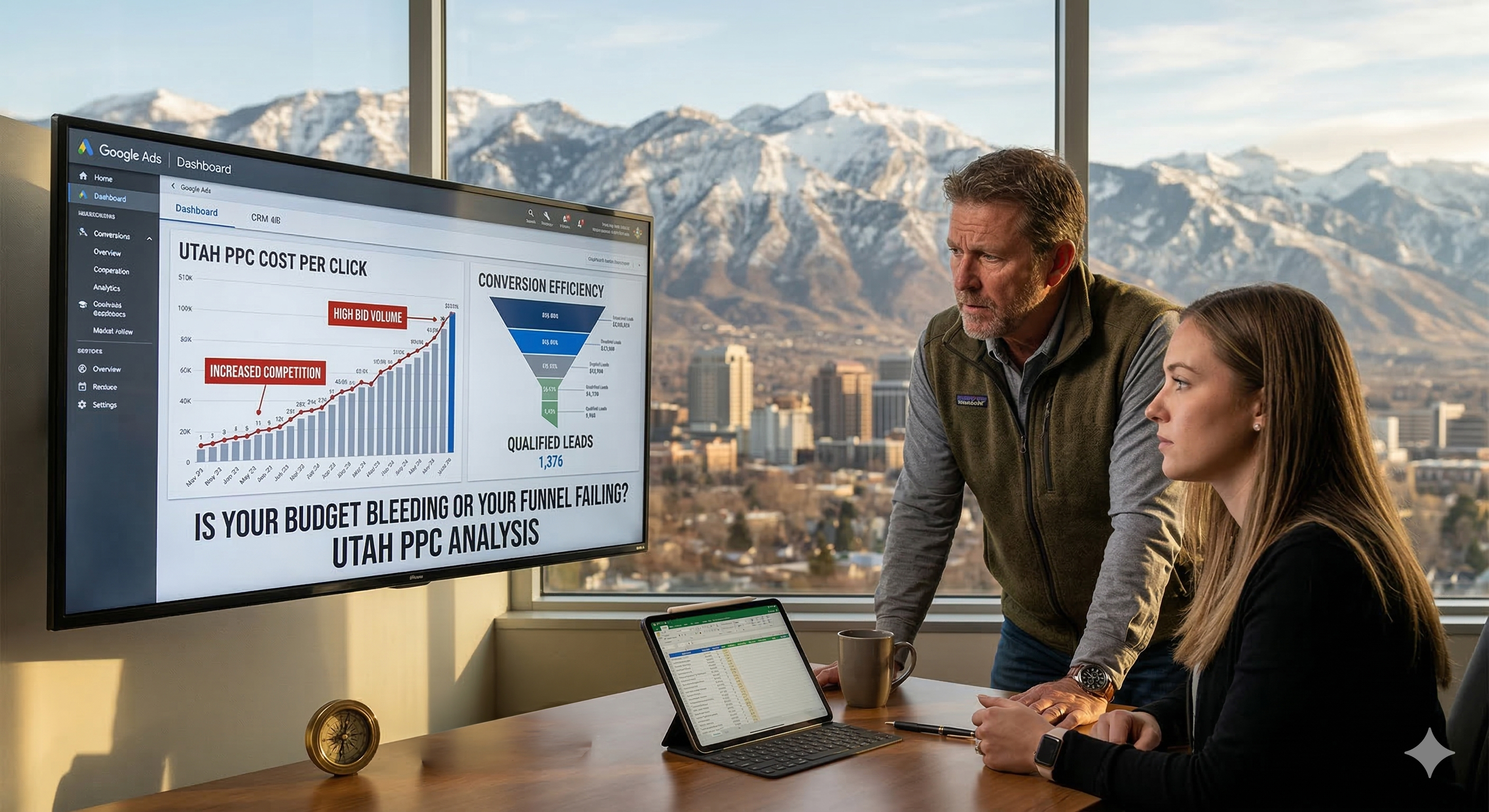
If you’ve run Google Ads in Utah recently, you’ve probably asked your team some version of this question: “Why are clicks so expensive right now?”
You aren’t imagining it. Costs have steadily climbed, especially for businesses operating along the dense Wasatch Front corridor. But here is what most business owners miss when auditing their ad spend: high ad costs usually aren’t the core problem. They are a signal.
And that signal is telling you something critical about your sales funnel.
Yes, the Utah Digital Market Is Highly Competitive
Utah boasts one of the highest concentrations of small businesses and tech companies per capita in the country. Between the startups in Lehi, established contractors in Orem, and corporate hubs in Salt Lake City, digital competition is fierce.
In the PPC world, this dense market means:
- More businesses are bidding on your exact keywords.
- The average Cost-Per-Click (CPC) is naturally driven up.
- Your smartest competitors are actively refining their conversion funnels.
So yes, running ads here is more competitive than in many other states. However, market competition alone rarely explains a complete lack of results.
The Real Question: What Happens After the Click?
This is where campaigns start to genuinely “feel” expensive. You are paying a premium for traffic, people are clicking your ads, but your conversions and lead volume remain stagnant. When this happens, the issue almost always falls into one of three buckets.
1. Your Website Isn’t Built to Convert
If your landing page loads slowly, looks generic, lacks a clear Call-to-Action (CTA), or buries essential trust signals, every single click is going to cost you more than it should.
In this scenario, the traffic isn’t necessarily bad; your site just isn’t doing its job to capture it. Ads simply amplify whatever your website currently is. If you send premium traffic to an unoptimized page, you will get poor results. This is why investing in conversion-first web design is often the most effective way to improve your ad performance.
2. Your Targeting Is Too Broad
Many local businesses accidentally bleed their budget by bidding on excessively broad keywords like “marketing company,” “web design,” or “Utah contractor.” These terms are highly expensive and incredibly vague regarding buyer intent.
A tighter pay-per-click campaign structure at accounts for specific cities, niche services, and high-intent phrasing will often lower your cost per qualified lead—even if your base CPC stays high. Better targeting doesn’t always mean cheaper clicks; it means better, more actionable clicks.
3. Your Offer Isn’t Aligned With Buyer Intent
This is the disconnect that surprises people the most. Utah buyers are practical. They comparison shop, read reviews, and evaluate credibility before they commit their dollars.
If your Google Ad promises a specific solution, but your landing page delivers something slightly different or makes it difficult to find that exact offer, your conversion rate will plummet while your cost per lead climbs. When your ad copy directly aligns with your landing page experience, campaigns immediately feel “cheaper” because your conversion efficiency skyrockets.
Why Ads Used to Work—And Now Don’t
It is incredibly common to hear business owners say, “But Google Ads worked great for us two years ago!”
Two years ago, competition was lighter, CPC was lower, and buyer expectations were much simpler. Today, your website needs to do significantly more of the heavy lifting. If your competitors have spent the last two years improving their user experience and you haven’t, your relative performance will drop—even if you haven’t touched your campaign setup.
The Difference Between Expensive and Inefficient
To succeed in a competitive landscape, you have to understand the difference between a high Cost-Per-Click (CPC) and a high Cost-Per-Acquisition (CPA).
You can easily survive—and thrive—with a high CPC if your conversion system is air-tight. But if your website, targeting, and messaging are disjointed, every click will feel painful to your budget. That’s the exact moment businesses mistakenly assume PPC is “broken,” when in reality, their system just needs professional recalibration.
What Growing Businesses Do Differently
Companies that consistently generate a strong ROI from their digital advertising don’t waste time asking how to lower click costs. Instead, they ask, “How do we increase our conversion efficiency?” That shift in mindset changes everything. High-performing companies:
- Perfectly align landing pages with ad intent.
- Segment their campaigns by specific cities or granular services.
- Track actual closed leads, not just vanity clicks.
- Improve their baseline website conversion rates before increasing their ad budget.
When to Get a Second Look
If your PPC campaign feels unsustainably expensive right now, ask yourself these three questions:
- Are you converting at least 5–10% of your high-intent traffic?
- Do you know your true Cost-Per-Acquisition?
- Is your landing page designed seamlessly around one clear, easy action?
If you are unsure about the answers, you likely don’t have a traffic problem. You have a system problem.
That’s where the team at Infogenix steps in. We don’t just run ads; we align your traffic, targeting, and digital marketing strategies into one cohesive performance engine.
Ready to stop paying for empty clicks? Contact Infogenix today for a comprehensive audit of your PPC campaigns and website conversion funnel.