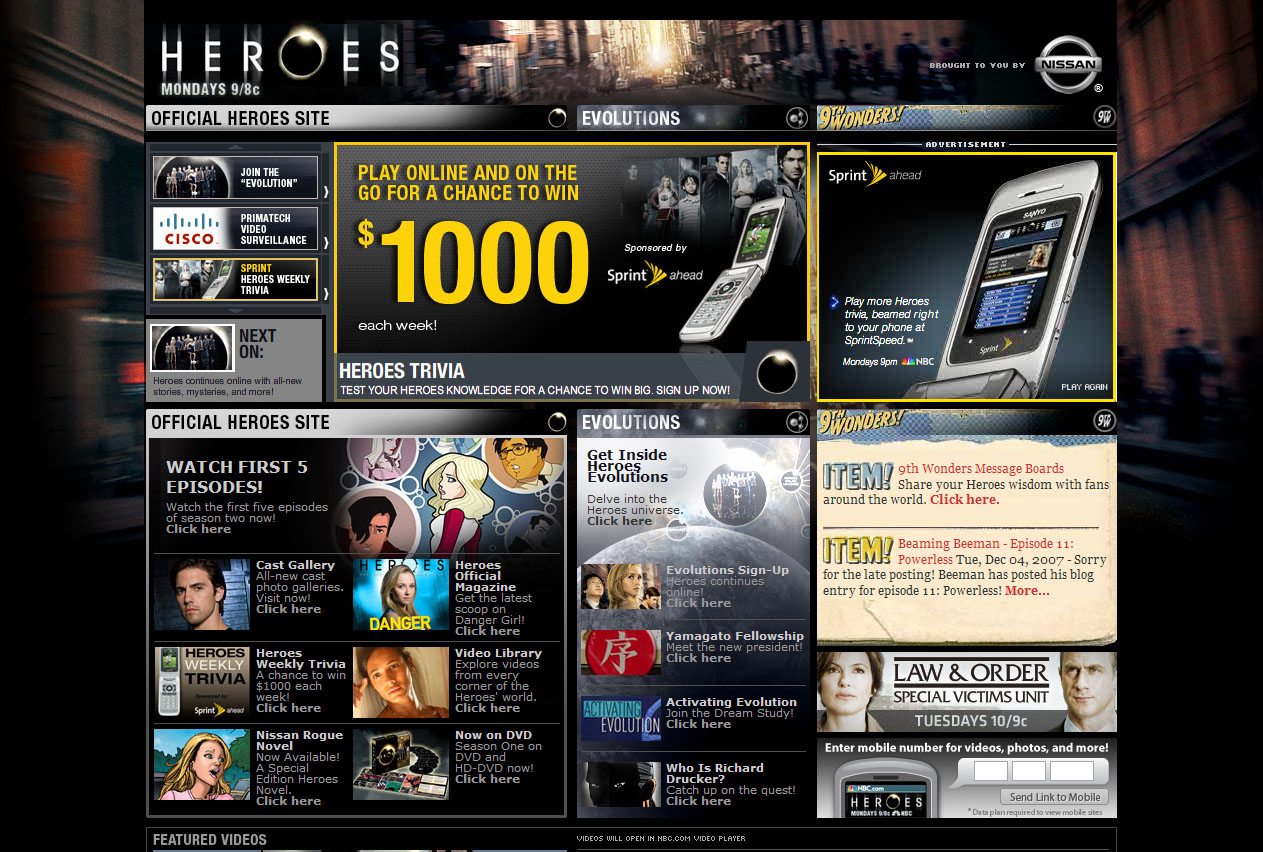
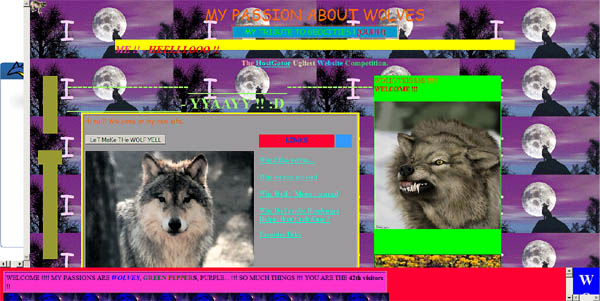
Raise your hand if you’ve ever seen an ugly website. Okay, I guess you don’t actually have to raise your hand, but I’m sure all of you would have if I could see you. This makes us wonder if there are so many bad websites, why haven’t designers stopped making them? The answer is simple really: they don’t realize they’re bad. If no one ever teaches you how to read, how can you learn? Well, the same goes for web design. Many designers want to show off their knowledge of photoshop by inserting countless styles and typefaces into a website.
A Cluttered Website Is A Cluttered Mind
Unfortunately, this leads to a cluttered, distracting appearance. Even more unfortunate is the inability to directly tell the designer what they have done wrong. With so few feedback systems being utilized by websites, designers are left high and dry to fix any mistakes by themselves. That’s why I’ve compiled this article on behalf of every upset website visitor out there. With a little luck, more than one designer will see this, realize their mistake, and begin creating beautifully designed masterpieces. Well, maybe not that far, but you get the point.
Simplicity Is Bliss
In the case of web design, simplicity beats out ignorance. You never want to distract visitors with overly colorful graphics or hard to read text. Remember that content is the most important thing on a webpage, not the design. Now this doesn’t mean you can’t have a nice, colorful website, but it does mean the colors have to be subtle. Just think of it like presenting a business presentation. You’d never try and get support for a company while wearing a neon green suit with red pinstripes, so why would your website be any different? Short answer: it’s not, and forgetting this can be the death of a site.
Design = Bridge Supports
Use Appearance To Support An Idea
Think of design like the trusses on a bridge. Or suspension cables. Really anything that supports the bridge will work fine. The point is that a website should represent a company. If you happen to be designing a site for a law firm, you’re going to want a simple, minimalist design, whereas something like a casino would want a more colorful site to represent the bright lights and late nights so common to them. Remember that you’re trying to make a design for the target market, not you. A site explaining medicare probably shouldn’t have flashing images and bright colors, lest we scare all the old people away. The best designers can base a website around any specific audience and can make it look good, too.
Ever since the first websites showed up, people have been diligently working on making them look more appealing. Nowadays, many sites are brilliantly designed, attracting visitors and keeping them on the page. However, how big of a role does a site’s look really playing in pleasing visitors? While the common web user will usually tell you the most important part of any webpage is the visual appeal, there is actually solid evidence that the appearance is not as important as previously thought.
What Is The Purpose Of Visual Design, Then?
Before we go any further, there is a very crucial distinction that must be made between attracting and maintaining visitors. Design is still integral to setting the tone of the website, whether it be anything from a professional site to one advertising a balloon store. If a website is terribly ugly, people are going to reach for that back button without hesitation. Ugly websites will always drive away visitors. On that note, visuals actually play a very small role in holding visitors for more than five seconds. The look certainly isn’t useless, but people are quickly beginning to realize that other aspects keep viewers on the page for longer.
Ugly Websites Are Still Bad
If Appearance Doesn’t Keep People On A Site, What Does?
Simplicity. Visitors to any site want to quickly be able to find what they are looking for. The simpler the website, the better. All websites should know what they offer and need to clearly advertise them on their home page. This doesn’t mean that an animal supply store should have thumbnails of every hamster ball or cat toy as soon as you see the page, but they should somehow clearly show where you can buy their products. Mastering the simplicity aspect of site building is essential for creating high quality, appealing websites.
How Appearance And Simplicity Go Hand In Hand
The one downside of clear cut, easy to navigate websites is they tend to be rather empty. Enter design. While the appearance doesn’t have much effect on how long a visitor will stay, creating a good first impression is the only way for businesses to showcase their services online. Having an attractive design will hold people for the first few seconds, which, though it may not sound like a lot, is just long enough to show the information on the homepage. These two aspects go perfectly together, and both must be present in full force if any website is to effectively sell their services online. Just because a site’s design isn’t as important as previously thought doesn’t mean it can be thrown away. In the end, there’s a reason people place such a focus on appearance; it’s what they want to see when they first land on a page.
What is Schema, and why you should be using it for SEO.
Schema.org’s Impact on SEO
When we embrace change with open arms, one of two things can happen. One, horrible things can happen, in this humble writer’s opinion, Google’s Panda update is a great example that really destroyed a lot of the low hanging SEO fruit and damaged the industry. The second scenario, we are rewarded with success when we choose to obey and not bite the hand that feeds. The latter being a great example of schema.org rich snippets.
Let’s take a step back and discuss what Schema.org rich snippets are. Schema.org is a multi-corporation partnership consisting of Google, Yahoo! and Microsoft, who’ve pooled together to create a universal markup language for simplifying users searches and giving yourself priority over sites that do not have schema, to bring in those conversion rates that you’ve been desiring, oh so much. Why would these mortal rivals pool to make something creative and useful? Here’s what schema.org has to say about that;
Here’s a real world example of what exactly Schema.org rich snippets are. You’re writing a blog post, and you say,”I love Mercedes.” Now when you’ve saved this and submitted your sitmap.xml file, about 4 weeks later when Google comes around to index your new posts, it has one of two ways of reading this phrase. I love Mercedes(car), or I Love Mercedes(Woman). In this example we’ll say you have not used schema.org markup, so now your webpage is in limbo and in all actuality you wont be ranking for either. Let’s go back in time 4 weeks, and teach you about schema markup. Now instead of, “I Love Mercedes”, it looks more like;
<div>
itemscope itemtype="http://schema.org/cars'>
I Love <span itemprop="name">Mercedes</span>
</div>
Whoa, mind blown. Google now sees your love for mercedes, not as a mistress but as an automobile. Now you’ll be properly indexed and all your visits will be a lot more natural and organic, with significantly less bounce rates than previously before. Schema.org has a large database that the search engine consortium is constantly updating that can just about cover and feasible event, award, medical practice or local business. Here’s my rule of thumb: If it’s a verb or a noun, they have specific diction to be used documented on schema.org that you should be using.
Next big problem, and definitely the most intimidating: How do I learn this?!
Google has got you covered again. http://www.google.com/webmasters/tools/richsnippets provides you with an easy to use GUI to markup all your pages in a timely manner and spit out the HTML necessary for you to copy and paste your way to first page results with zero knowledge of any geeky programming language. That’s right, you get to avoid the pocket protectors and the Klingon language because of Google, lucky you.
Here are some of the main categories that you can expect to find at Schema.org with their definitions. Keep in mind, there are so many sub categories that it is not worth listing them all, and for simplicity’s sake you should use google webmaster’s structured data tool for most if not all your schema needs. (Unless you are going for a super-niche market, or niche consumer base.)
THESE ARE ROUGH DEFINITIONS AND VARY GREATLY DEPENDING ON USEAGE
Each of these topics below are broad encompassing topics that provide ease of access by narrowing it down by what you want to do. SEO wise, you’ll have to use good judgement on what you exactly want to promote to Google, and what not to promote.
/Action (EXAMPLE: The location of the event, organization or action. When the Action was performed: start time. This is for actions that span a period of time. e.g. John wrote a book from *January* to December.)An action performed by a direct agent and indirect participants upon a direct object. Optionally happens at a location with the help of an inanimate instrument. The execution of the action may produce a result. Specific action sub-type documentation specifies the exact expectation of each argument/role.
/Broadcast Service(EXAMPLE: The organization owning or operating the broadcast service, or The area within which users can expect to reach the broadcast service.) A delivery service through which content is provided via broadcast over the air or online.
/Creative Work(EXAMPLE:An award won by this person or for this creative work, The publisher of the creative work, or The organization or agency that is providing the service.) The most generic kind of creative work, including books, movies, photographs, software programs, etc.
/Event(EXAMPLE:The location of the event, organization or action, or A person or organization attending the event. ) An event happening at a certain time and location, such as a concert, lecture, or festival. Ticketing information may be added via the ‘offers’ property. Repeated events may be structured as separate Event objects.
/Intangible(EXAMPLE:Really niche markets, or otherwise unstated markups would fall under Intangible ) Not Relevant (Alignment Object, Audience, Brand, Demand, Enumeration, Job Posting, Language, Offer, Permit, Quantity, Rating, Service, Service Channel, Structured Value)
/Medical Entity(EXAMPLE: If applicable, a medical specialty in which this entity is relevant, or A medical study or trial related to this entity.) The most generic type of entity related to health and the practice of medicine.
/Organization(EXAMPLE:A logo associated with an organization, a local business, a review, a telephone number, an employee. ) An organization such as a school, NGO, corporation, club, etc.
/Person(EXAMPLE: Owner, proprieter, customer, patient, doctor) A person (alive, dead, undead, or fictional)
/Place(EXAMPLE:a map, an event, a phone number, an address for a business ) Entities that have a somewhat fixed, physical extension.
/Product(EXAMPLE:Release date, reviews, logo, manufacturer ) A product is anything that is made available for sale—for example, a pair of shoes, a concert ticket, or a car. Commodity services, like haircuts, can also be represented using this type.
/Property(EXAMPLE: connected pages that are different locations but still the same business. Multiple storefronts, but all websites are owned by the same entity) A property, used to indicate attributes and relationships of some Thing. (another website that the primary website owns
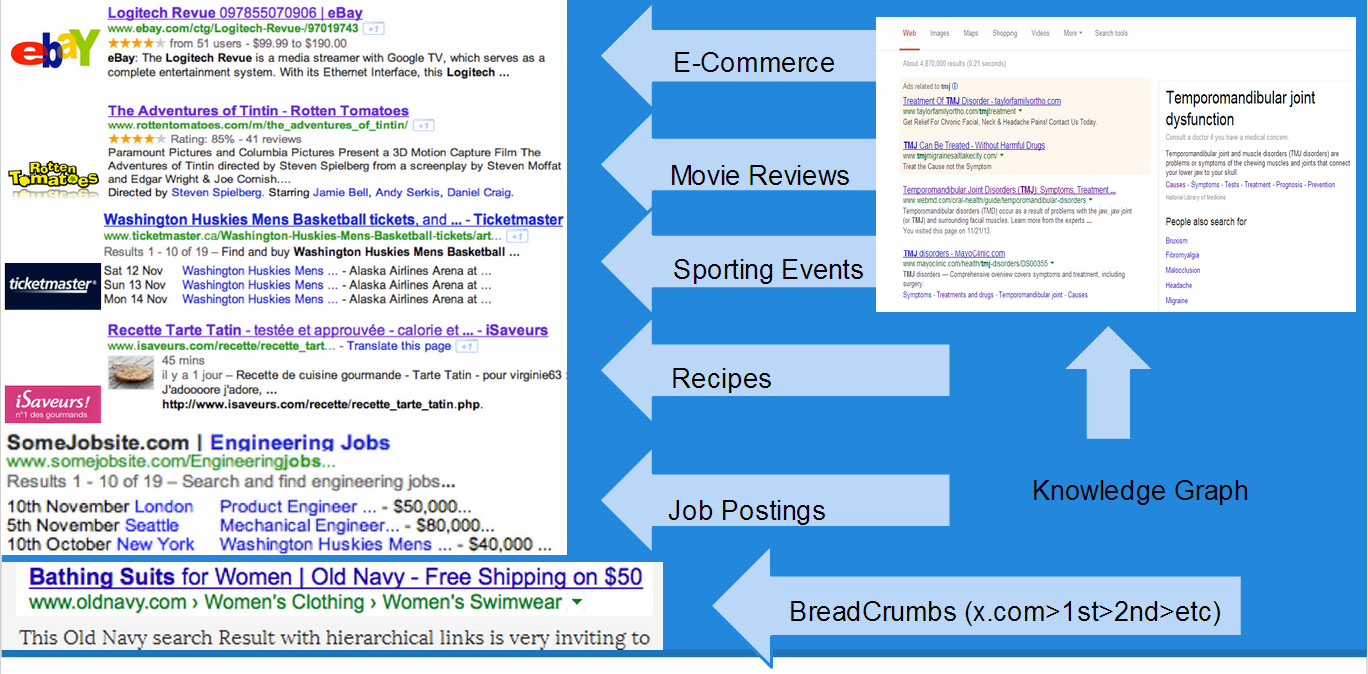
Let’s talk business, and get down to brass tacks. Results. Here is an image of what kinda of changes you can see by adding these schema markup rich snippets.
Rich Snippet types
As you can see, is you correctly markup applicable Schema, you can bring proprietary data that is typically not indexed on the SERPs your page pulls up in. Awesome sauce!
As you can see, schema.org is a great resource and a free, and a plainly more effective alternative to keyword stuffing or any other futile attempts to manipulate your rankings. Schema.org. Use it.